

- Academic Enrichment
- Admissions
- Art
- Campaign
- CCF
- Chapel
- Chemistry
- Classics
- Co-curricular
- Community
- Dance
- Design and Technology
- Drama
- Duke of Edinburgh
- Economics
- English
- Equestrian
- Farm
- Foundation
- General
- Geography
- History
- Houses
- Library
- Mathematics
- Modern Foreign Languages
- Music
- OLs
- Outreach
- Photography
- Science
- Scouts
- Sport
- Sports
- Trips and Visits
- UCAS/Careers
Head Master’s Lecture: Music and the Brain

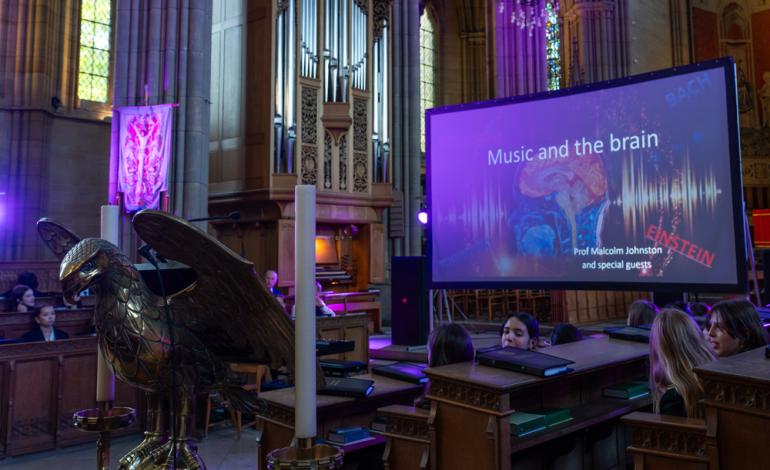


On Wednesday 14 May 2025, Dr Malcolm Johnston, Professor of Radiology and Medical Education at Brighton and Sussex Medical School visited Lancing College to give a fascinating Head Master’s Lecture entitled Music and the Brain.
Professor Johnston, also a violinist, pianist and conductor, impressed the keen audience by demonstrating his scientific understanding of music. He discussed Western classical music traditions, world music from other cultures and even Guns & Roses, using musical examples to support his research. The professor himself played snippets on the piano, Alexander Mason played an improvised piece on the organ and Eva Al-Shimmeri played a spell-binding performance of the second movement of Henri Casadesus’ Viola Concerto in C minor in the Style of J.C. Bach.
Professor Johnston also expertly conducted the Lancing College Choir for their performances which included If Ye Love Me by Thomas Tallis and Locus Iste by Anton Bruckner. Ancient research from Pythagoras explains that musical intervals can be mathematically defined by using the ratios of a length of string to find the corresponding pitches (which is why the octave and the perfect fifth are the most commonly used intervals in this musical tradition).
Professor Johnston used modern brain imaging techniques to demonstrate to the audience what happens to our brain when we listen to different pieces of music. He showed what parts of our brain ‘light up’ when we listen to music with different levels of familiarity, showing MRI images of his own brain from recent research. Professor Johnston used his cutting-edge research to complete a well-rounded, detailed analysis of how Western classical music has developed over time and why the 12-note chromatic scale is the basis of this tradition. Anything outside of these recognisable notes (such as microtones) sounds unusual to those brought up with this genre of music, as opposed to those from other communities who use a wider variety of frequencies. Our brains activate areas associated with auditory processing (the motor cortex and basal ganglia) when we listen to music which explains our innate desire to dance, tap our feet or nod our heads when we listen to music. These areas are also responsible for the way that music makes us feel. Using a live poll, Professor Johnston demonstrated that the emotional context (happy or sad) that a piece of music inspired within the audience was mostly uniform. This showed that music has decipherable elements such as tonality, rhythm, harmony and timbre that influence our emotional perception, even when a piece is completely new to the listener.
The choir closed the lecture with a spine-tingling performance of Lacrimosa from Mozart’s Requiem, which further demonstrated the psychological power of music. The structure of this lecture-recital combined two, seemingly opposing studies in an effective and seamless manner and Professor Johnston proved that both Science and Music are intrinsically linked.
Constance Starns – Graduate Music Assistant